Demos
Demos  Colors
 Docs
Docs  Support







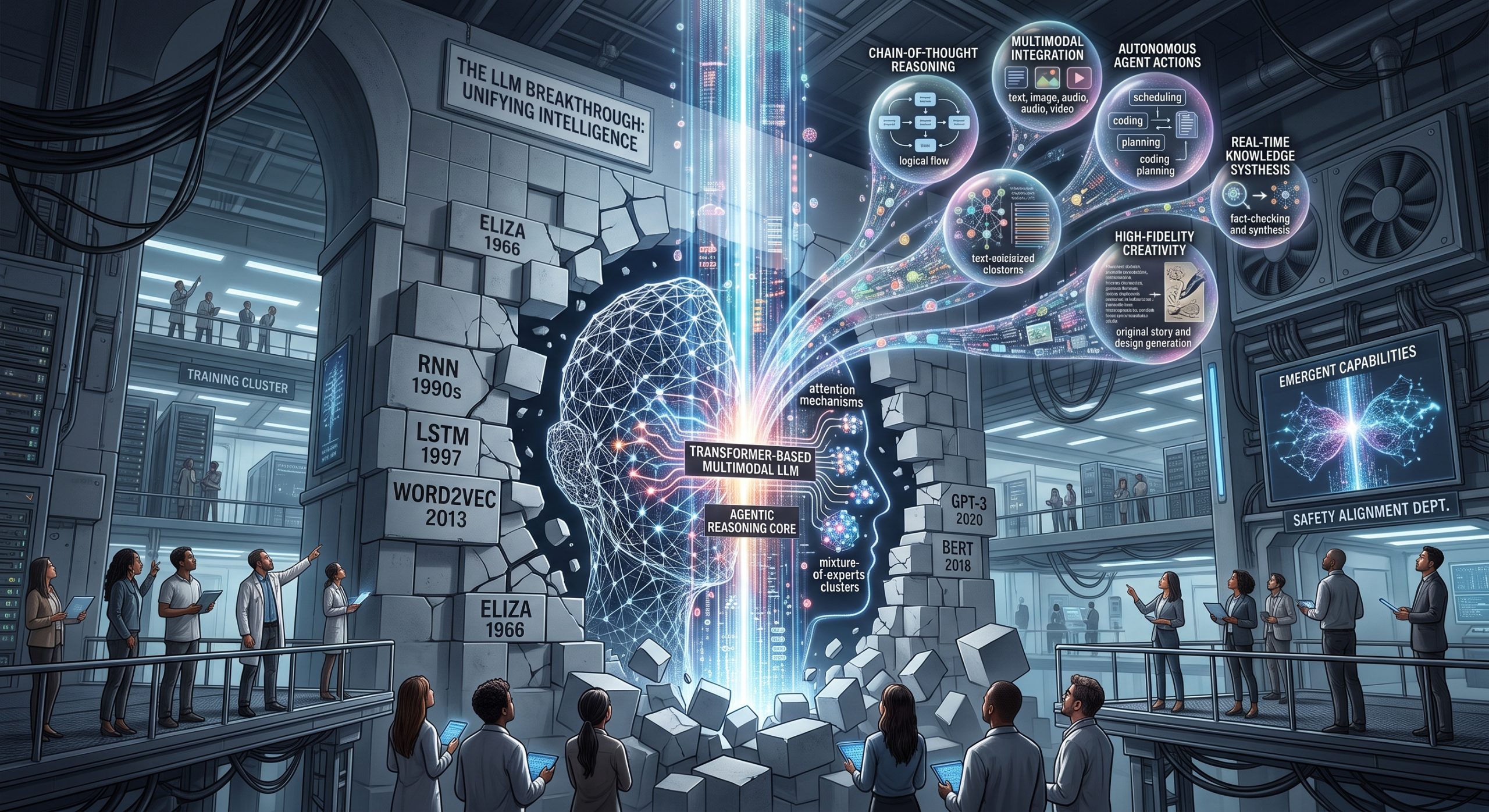
Modern AI assistants did not appear overnight. Their development can be traced through decades of research—but one architectural change created a particularly important turning point.
Large language models, commonly called LLMs, can now draft emails, translate text, summarise documents, assist with research, generate software code, and answer questions in conversational language.
Their abilities can make the technology seem like a sudden invention. In reality, today’s systems emerged from many years of progress in computing, data, machine learning, and language research.
There is no universally accepted date for the “first real” LLM breakthrough. Different researchers may point to different milestones. However, one development is widely recognised as especially important: the introduction of the Transformer architecture in 2017.
The Transformer did not create modern conversational AI by itself. It did, however, provide a more efficient foundation for training increasingly capable language models.
Understanding why it mattered helps explain how LLMs developed—and why their limitations remain important.
Before LLMs: Teaching Computers to Process Language
Researchers have been trying to make computers understand and generate language for decades.
Early systems often relied on manually written rules. Developers attempted to define how sentences were structured, what individual words meant, and how a program should respond to specific inputs.
These systems could work in carefully controlled situations, but human language is rarely predictable. The same word can have several meanings, sentences can depend on earlier context, and people regularly use humour, abbreviations, cultural references, and incomplete information.
Machine-learning methods offered another approach. Instead of attempting to write every language rule manually, researchers trained systems to identify statistical patterns in large collections of text.
This led to progress in areas such as:
- Speech recognition
- Machine translation
- Search engines
- Text classification
- Email filtering
- Predictive keyboards
- Sentiment analysis
However, processing long passages remained difficult.
The Challenge of Remembering Context
Before Transformers, many language systems used recurrent neural networks, or RNNs. More advanced variations included long short-term memory networks, known as LSTMs.
These systems processed text largely in sequence. They examined one element after another while attempting to carry useful information forward.
This approach was logical because people read sentences in order. But it created practical limitations.
Training could be slow because each step depended on the previous one. The system might also struggle to preserve important information across a long passage.
Consider the following sentence:
“The book that Daniel borrowed from the library after speaking with his professor was eventually returned.”
To understand what “was eventually returned” refers to, a model needs to connect the end of the sentence with “the book” near the beginning. Longer documents create far more complicated relationships.
Researchers needed a better way for models to determine which parts of a passage were relevant to one another.
Attention Changed the Direction of Language Research
Before the Transformer, researchers had already developed methods known as attention mechanisms.
Attention allowed a model to assign different levels of importance to different parts of an input. Instead of treating every word equally, the system could focus more closely on the information most relevant to the current task.
This was useful in machine translation. When translating a word, the model could examine related words in the original sentence rather than relying only on a compressed representation of everything it had processed.
Attention was already an important development. The next step was to make it the central organising principle of an entire architecture.
The 2017 Paper That Introduced the Transformer
In June 2017, eight researchers published a paper titled Attention Is All You Need.
The paper proposed a new architecture called the Transformer. Rather than building the model primarily around recurrence or convolution, the researchers created a system based on attention mechanisms.
The original experiments focused mainly on translation. According to the paper, the proposed models achieved strong results while being more parallelisable and requiring less training time than the approaches with which they were compared. The original Attention Is All You Need paper is available through the NeurIPS proceedings.
Parallelisation was especially important.
A recurrent model generally processes a sequence step by step. A Transformer can perform more of its calculations simultaneously. This makes it better suited to the specialised processors used for modern machine learning.
It did not make training easy or inexpensive. It made training larger models more practical.
What “Self-Attention” Means in Simple Terms
Self-attention helps a model evaluate relationships between elements within the same input.
Take this example:
“Maria placed the glass on the table because it was wet.”
What does “it” refer to—the glass or the table?
A language model must examine the relationships between the words and use context to estimate the intended meaning. Self-attention gives the model a mechanism for weighing those relationships.
Modern models apply this process across many layers and attention components. During training, they learn statistical patterns that help them estimate which pieces of information are relevant in a particular context.
This does not mean the model understands language exactly as a person does. It means the system can calculate useful relationships between units of text and use them to predict an appropriate output.
Why the Transformer Was a Breakthrough
The Transformer mattered for several connected reasons.
It made parallel training more practical
Because more calculations could be performed simultaneously, researchers were better able to use modern computing hardware.
It handled relationships across text more effectively
Attention gave models a direct mechanism for connecting relevant words or tokens, even when they were separated within a passage.
It could be scaled
Researchers could train larger models using more data and computing resources. Scaling alone did not guarantee better performance, but it became an important part of later development.
It was adaptable
Although the original paper concentrated on translation, Transformer-based systems were subsequently applied to search, classification, question answering, text generation, image processing, audio, and other areas.
For these reasons, the Transformer is a strong candidate for the first major architectural breakthrough of the modern LLM era.
It was not the first advance in language AI, and it was not the final step. It was the foundation on which several later advances were built.
BERT Demonstrated the Power of Pre-Training
One important follow-up appeared in 2018 with BERT, which stands for Bidirectional Encoder Representations from Transformers.
BERT was designed to learn language representations from large amounts of unlabelled text. It could then be adapted for tasks such as question answering and language classification with relatively limited task-specific modification.
Its bidirectional approach allowed the model to use context from both sides of a word during pre-training. The original research reported strong results across multiple language-understanding benchmarks. The BERT research paper explains its architecture and reported evaluations.
BERT helped demonstrate a powerful development model:
- Train a general language system on a broad collection of text.
- Adapt that system to more specific tasks.
This reduced the need to build an entirely separate model for every language problem.
GPT-3 Made In-Context Learning More Visible
Another significant milestone arrived in 2020 with GPT-3.
GPT-3 was an autoregressive Transformer-based language model. It generated text by predicting likely continuations based on the information that came before.
Its researchers investigated whether a sufficiently large model could perform new tasks from instructions or a small number of examples without conventional task-specific retraining.
The published results showed that increasing model scale substantially improved performance across many few-shot tasks, although the system continued to have important weaknesses. The GPT-3 paper, Language Models Are Few-Shot Learners, is available through NeurIPS.
This helped establish the idea that one general model could perform many different language tasks through prompting.
Instead of installing a separate system for summarisation, translation, drafting, and question answering, users could describe the desired task in ordinary language.
Conversational AI Required More Than a Larger Model
A powerful underlying model does not automatically become a useful assistant.
Developers also needed methods for aligning model behaviour more closely with human instructions. This included collecting feedback, improving safety systems, refining interfaces, and teaching models to respond more helpfully in a conversational format.
The familiar chatbot experience therefore reflects several layers of development:
- The Transformer architecture
- Large-scale pre-training
- Improved computing infrastructure
- Better training data and data-processing methods
- Instruction tuning
- Human-feedback techniques
- Safety testing
- User-friendly interfaces
Calling any one of these the only breakthrough would overlook the cumulative nature of AI research.
Still, without the Transformer, the path to many present-day LLMs would likely have looked very different.
What LLMs Actually Do
Despite the term “intelligence,” an LLM does not function like a searchable database of guaranteed facts.
The model analyses an input and produces a likely sequence of tokens based on patterns learned during training and information provided in its current context.
This approach can produce fluent and useful text. It can also produce inaccurate, invented, outdated, or misleading answers.
A confident tone is not evidence that an answer is correct.
LLMs may be helpful for:
- Creating an initial draft
- Summarising user-provided information
- Rewriting text in a different tone
- Brainstorming possible ideas
- Explaining general concepts
- Organising notes
- Generating practice questions
- Assisting with certain programming tasks
Their output should be independently checked when accuracy matters.
The Limits Have Not Disappeared
Newer models may perform better on many evaluations, but the fundamental risks of automated generation remain.
Potential limitations include:
- Incorrect factual claims
- Invented sources or quotations
- Misinterpretation of ambiguous instructions
- Outdated information
- Biases inherited from data or system design
- Inconsistent answers
- Privacy risks when users upload sensitive information
- Difficulty recognising when expert judgment is required
Users should not rely solely on an LLM for medical diagnoses, legal decisions, financial recommendations, safety procedures, or other high-stakes matters.
Confidential business information, passwords, payment details, identity documents, and private records should not be entered into an AI service without understanding how that service handles data.
Was the Transformer Really the First LLM Breakthrough?
The answer depends on how “breakthrough” is defined.
If the term means the earliest attempt to process language statistically, the history goes back much further.
If it means the first use of attention, important work predates 2017.
If it means the moment general-purpose language models became accessible to a broad public, later conversational systems may be the more visible milestone.
But if the question is which architectural development provided the foundation for many modern LLMs, the Transformer is one of the strongest answers.
It connected attention-based processing with an architecture that could be trained efficiently on modern hardware and scaled to increasingly demanding tasks.
Progress Came From a Sequence of Advances
The history of LLMs is not a story of one invention suddenly producing modern AI.
It is a chain:
- Statistical language modelling showed that text contains learnable patterns.
- Neural networks improved how those patterns could be represented.
- Attention helped models focus on relevant context.
- Transformers made attention central and enabled more parallel training.
- Pre-training allowed general models to be adapted to multiple tasks.
- Scaling improved certain forms of task performance.
- Instruction tuning and human feedback made conversational systems more usable.
Each stage depended on earlier research, improved hardware, larger datasets, and extensive experimentation.
Why the 2017 Breakthrough Still Matters
The Transformer paper is important not because it completed the development of artificial intelligence, but because it changed the technical direction of language modelling.
It helped make possible systems that can work with text at a scale and level of flexibility that earlier architectures struggled to achieve.
The technology has continued to evolve, and future systems may use modified or entirely different architectures. For now, however, the Transformer remains one of the central foundations of the LLM era.
The first real breakthrough was not a chatbot, a viral demonstration, or a dramatic announcement. It was a research architecture that made a new generation of language models practical—and opened the door to the systems people are still learning how to use responsibly today.
EDITORIAL DISCLAIMER
This article is intended solely for general educational purposes. AI capabilities, availability, costs, and performance vary between systems and may change over time. References to particular models or organisations do not constitute endorsements. AI-generated information can be inaccurate and should be independently verified, especially before making medical, legal, financial, employment, or safety-related decisions.
Post a comment
Related Posts

15 September 2026
Canada–US Tariffs: How a Trade Dispute Is Reshaping North America
The two neighbours have moved from difficult negotiations to matching tariffs, import restrictions and a…

9 July 2026
How a Truck Driver Cleared $40,000 in Debt and Paid Off His Mortgage 20 Years Early
This article describes one person’s reported experience. Financial circumstances and outcomes vary. For Melbourne truck…

22 January 2026
The Power of Emotion: How TV Show Hosts Shape Audience Engagement and Success
In the world of television entertainment, the host is far more than a presenter. They…

22 October 2025
5 Key Strategies to Drive Business Growth in 2026
As we move further into 2026, businesses face a dynamic and rapidly evolving landscape. Emerging…